
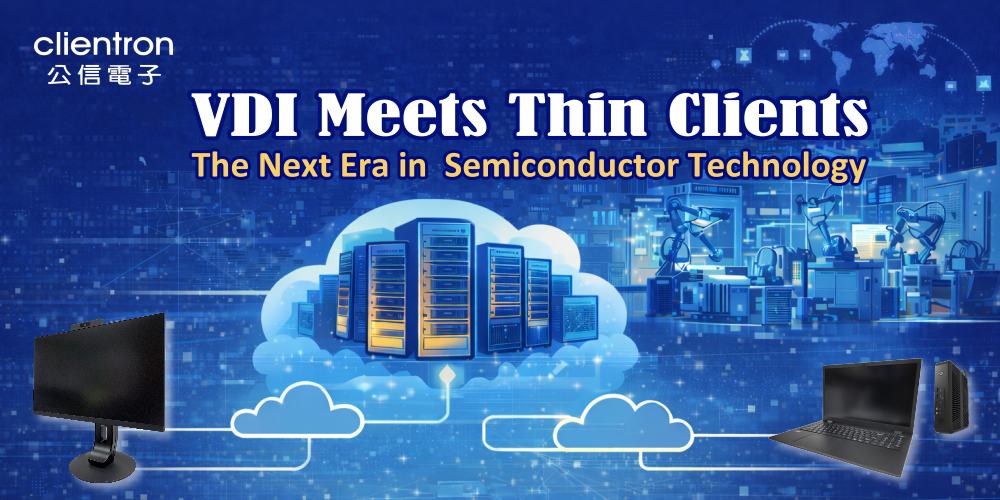
In the semiconductor industry, design data, process recipes, and yield information are the core assets of the business. A single data leak can destroy years of research and development and severely damage customer trust. At the same time, chip companies must support global collaboration, smart fab projects, and hybrid work environments. To balance security, productivity, and flexibility, many organizations are adopting Virtual Desktop Infrastructure (VDI) combined with thin clients.
1. Robust Protection for Intellectual Property and Process Data
Traditional PCs store project files and tool settings locally, which makes them vulnerable to data exposure if laptops are lost, infected by malware, or misconfigured. In contrast, a VDI (Virtual Desktop Infrastructure) combined with a thin client model keeps all applications and data within the data center or private cloud. The endpoint device only displays the screen image and transmits user input.
This means:
- design IP or production data is stored on the client device.
- Damaged terminals can be disabled instantly without wiping any data.
- Security controls, encryption, and access policies are enforced centrally.
This architecture facilitates passing customer security audits and ensures compliance with standards such as ISO 27001, while maintaining strict control over critical know-how.
2. Predictable Performance in Design and Fab Operations
Semiconductor workflows are computationally intensive, involving multi-gigabyte design databases, simulation and verification tasks, and real-time equipment control. Performance differences between individual PCs can delay projects at the most critical moments.
With VDI, computing and storage resources are pooled in high-performance servers and GPU nodes. Thin clients provide a consistent front end.
- Virtual desktop images for design, manufacturing, test, and IT.
- "PC drift" caused by drivers, patches, or personal software.
- Stable behavior performance in cleanrooms, control rooms, and offices.
When additional power is required, IT scales server resources rather than upgrading each workstation, ensuring engineers and operators remain productive with minimal disruption.
3. Simplified 24/7 Operations and IT Management
Fabs never stop. Managing thousands of full PCs across production lines and offices is costly and resource-intensive. Thin clients are simpler, more robust, and have longer lifecycles, making them ideal for harsh or controlled environments.
When combined with VDI, IT can:
- Maintain a few standardized "golden" OS images instead of unique PCs.
- Roll out patches and application updates centrally.
- Bring new workstations online quickly by plugging in a thin client and assigning a virtual desktop.
- Replace faulty devices in minutes without any data loss.
This frees IT teams to focus on higher-value initiatives such as smart manufacturing, data analytics, and OT(Operational Technology)/ IT(Information Technology) integration.
4. Secure Global Collaboration and Hybrid Work Environments
Chip design and production are global activities. Engineers and operators need secure access to tools and data from offices, homes, customer sites, and partner facilities.
VDI with thin clients supports this by:
- Delivering the same desktop environment anywhere, regardless of where the user logs in.
- Keeping heavy EDA(Electronic Design Automation) and data-intensive processing close to the data center, reducing transfers of large project files.
- Allowing fine-grained control over who can access which project, from which location, and for how long.
This model enables "follow-the-sun" collaboration without compromising control over intellectual property.
5. Reduced Cyber Risk and Accelerated Recovery
Ransomware and targeted attacks on high-tech manufacturing have become routine. With VDI and thin clients, endpoints store no valuable data, significantly reducing the attack surface. Centralized patching and monitoring simplify vulnerability remediation and enable early detection of suspicious activity. If a virtual desktop is compromised, it can be quickly restored from a clean snapshot, which is much faster than reimaging dozens of physical PCs.
6. Lower Total Cost of Ownership (TCO) and Enhanced Sustainability
Thin clients generally cost less, last longer, and consume less power than traditional PCs. In large fabrication plants and design centers, this reduces the total cost of ownership and supports corporate sustainability and ESG goals. Centralizing computing resources in efficient data centers further decreases energy consumption while maintaining high performance.
For semiconductor companies, VDI combined with thin clients represents far more than a simple hardware upgrade. It is a strategic platform that integrates IP protection, predictable performance, simplified IT management, secure global collaboration, cyber resilience, and cost efficiency. As the industry advances into increasingly complex nodes and systems, organizations that adopt this architecture will be better positioned to protect their most valuable assets and move faster than the competition.
About Clientron
Clientron was founded in 1983. The company is dedicated to providing highly integrated embedded solutions to our clients worldwide. With over 35 years of experience in design, manufacturing, and after-sales service, Clientron offers high-quality, technology-leading solutions and is committed to providing engineering excellence in pursuit of innovative solutions and outstanding service to global partners and customers. Visit us at https://www.clientron.com/